Unlocking Efficient Collaboration and Reporting in Information Security with Dradis Framework
Penetration Testing as a service (PTaaS)
Tests security measures and simulates attacks to identify weaknesses.
Abstract
As information security professionals navigate the complex landscape of security assessments and testing engagements, effective collaboration and reporting are critical for success. One tool that has gained popularity in the information security community for facilitating these tasks is Dradis Framework. In this article, we will explore the features, benefits, and applications of Dradis Framework, an open-source collaboration and reporting platform that can streamline information sharing, improve communication, and enhance reporting in the context of security assessments.
Introduction
Information security assessments, such as penetration testing, vulnerability scanning, and compliance audits, play a crucial role in identifying and addressing security weaknesses in systems, networks, and applications. These assessments typically involve a team of security professionals working together to gather, organize, and analyze security-related information, and to communicate their findings and recommendations to stakeholders, including clients, management, and other team members.
However, managing and sharing information in the context of security assessments can be challenging. Security professionals often face issues such as scattered and unorganized data, lack of collaboration among team members, and cumbersome reporting processes. This can result in inefficiencies, errors, and delays in the assessment process, and may even compromise the quality of the final reports.
This is where Dradis Framework comes into the picture. Dradis is an open-source collaboration and reporting platform specifically designed for information security teams. It provides a web-based interface for teams to create, edit, and collaborate on security-related documentation, such as findings, notes, and recommendations, and offers features such as customizable templates, integration with security testing tools, and reporting functionality. With its user-friendly interface and powerful features, Dradis Framework can significantly improve collaboration and reporting in information security assessments.
In this article, we will delve into the various aspects of Dradis Framework, including its features, comparison with other tools, and applications. We will explore how Dradis can be used to streamline information sharing, enhance communication, and improve reporting in information security assessments. We will also discuss real-world use cases and best practices for leveraging Dradis Framework effectively.
Features of Dradis Framework
Dradis Framework offers a wide range of features that can be leveraged by information security teams to streamline their collaboration and reporting efforts. Some of the key features of Dradis Framework include:
Web-based Interface: Dradis provides a web-based interface that allows teams to create, edit, and collaborate on security-related documentation. This web-based interface can be accessed from anywhere, making it convenient for distributed teams to collaborate effectively.

Figure 1: Dradis Dashboard
Customizable Templates: Dradis allows users to create and customize templates for standardized reporting. This enables teams to maintain consistency in their reports and ensures that the reports meet the specific requirements of their clients or stakeholders.
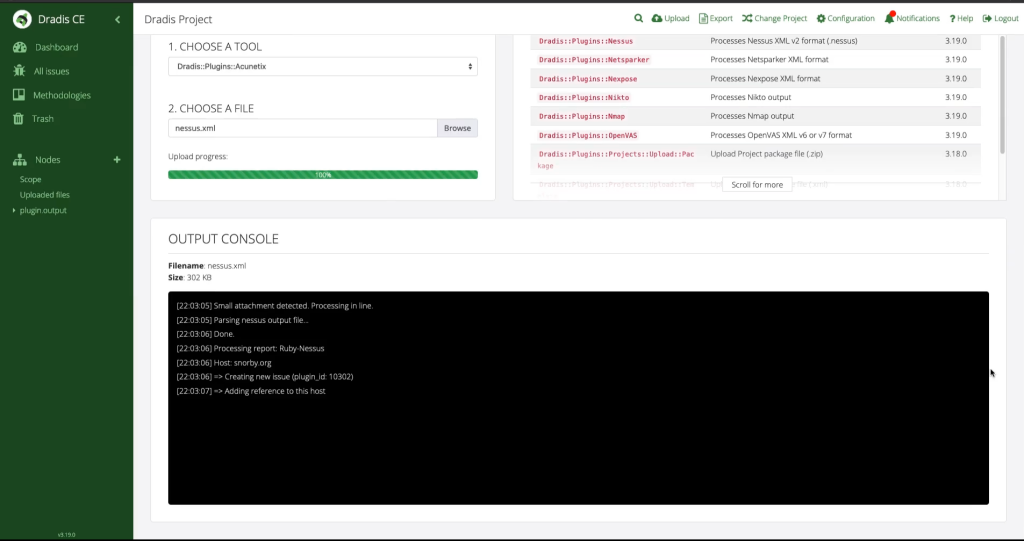
Integration with Security Testing Tools: Dradis offers integration with various security testing tools, allowing users to import findings from automated scanning tools, such as Nessus, OpenVAS, and OWASP ZAP, directly into the platform. This can save time and effort in manually entering findings, reduce the risk of human error, and ensure that all findings are captured in one central location.

Figure 2: Uploading Nessus report
Reporting Functionality: Dradis provides reporting functionality that allows users to generate professional-looking reports in various formats, such as PDF and HTML. Reports can be customized based on the template and can include findings, notes, recommendations, and other relevant information. Dradis also supports the generation of executive summaries and findings matrices, which can be useful for communicating the assessment results to different stakeholders.

Figure 3: Generated HTML report
Collaboration Features: Dradis offers collaboration features that facilitate communication and information sharing among team members. Users can add comments, tags, and attachments to findings, and can also assign findings to specific team members for review or follow-up actions. This promotes effective communication, reduces miscommunication, and ensures that all team members are on the same page throughout the assessment process.

Figure 4: Issue Portal
Search and Filtering: Dradis allows users to search and filter findings, notes, and other documentation based on various criteria, such as severity, status, or tags. This makes it easy to locate and retrieve relevant information quickly, improving the efficiency of the assessment process.
Project Management: Dradis provides project management features that allow users to organize assessments into projects, assign team members to specific projects, and track the progress of assessments. This helps teams to manage multiple assessments simultaneously and ensures that assessments are completed on time and within budget.
Flexibility and Customization: Dradis is highly flexible and customizable, allowing users to configure the platform to suit their specific needs and requirements. Users can create custom fields, templates, and workflows, and can also integrate Dradis with other tools and services to enhance its functionality.
Comparison of Dradis Framework with other Tools
When it comes to reporting and documentation tools for security assessment, there are several other options available in addition to Dradis. Let’s compare Dradis with some of these tools:
Dradis v/s ReportPortal
ReportPortal is a powerful open-source reporting tool for security assessments that provides a centralized platform for managing and documenting security findings. It offers features such as customizable dashboards, automated report generation, and integrations with popular security testing tools. While Dradis is also open-source and provides collaborative reporting, Dradis has a broader focus on overall security assessment reporting, whereas ReportPortal is specifically designed for security testing.
Dradis v/s Microsoft Word/Excel
Traditional office productivity tools like Microsoft Word and Excel are often used for reporting and documentation in security assessments. They offer a wide range of formatting and data manipulation options, but they lack specific features tailored to security assessments, such as automated data input, collaboration capabilities, and built-in security assessment templates, which are offered by dedicated security assessment tools like Dradis.
Dradis v/s Markdown Editors
Markdown editors are lightweight text editors that use Markdown language to create formatted documents. Tools like Visual Studio Code, Typora, and Notion are popular markdown editors that can be used for documenting security assessments. They provide simplicity and flexibility in creating formatted documents, but they lack specific features for security assessment collaboration and reporting that are offered by dedicated tools like Dradis.
Dradis v/s JIRA
JIRA is a widely used issue tracking and project management tool that can also be used for documenting security assessments. It offers features such as ticketing, workflow management, and collaboration capabilities, which can be used to track security findings and document assessment results. However, JIRA is not specifically designed for security assessments and may require additional customization to cater to security assessment reporting needs, whereas Dradis is purpose-built for security assessments.
Dradis v/s Custom Build Solutions
Some organizations may prefer to build custom in-house solutions using web-based frameworks or other technologies to document and report on security assessments. Custom-built solutions provide the flexibility to tailor the reporting and documentation process to specific organizational needs. However, building and maintaining custom solutions can be time-consuming, resource-intensive, and may lack the comprehensive features and support offered by dedicated tools like Dradis.
In summary, while there are other reporting and documentation tools available for security assessments, Dradis stands out as a dedicated open-source tool that offers rich features with popular security testing tools. Other tools may provide general-purpose reporting capabilities but may lack the specific features required for security assessments. The choice of tool depends on the specific requirements and preferences of the security team and organization.
Applications of Dradis Framework
Dradis Framework can be applied in various information security assessment scenarios, including:
Penetration Testing: Dradis can be used by penetration testing teams to organize and document their findings, notes, and recommendations. Penetration testers can import findings from automated scanning tools, add their own findings, and collaborate with team members to analyze and document their findings in a structured and organized manner. This can help in generating professional-looking reports that capture all the findings and recommendations and can be shared with clients and other stakeholders.
Vulnerability Scanning: Dradis can also be used by vulnerability scanning teams to centralize and document their vulnerability findings. Vulnerability scanners can import their scan results into Dradis, and use its features to organize, prioritize, and track the remediation of vulnerabilities. The collaboration and reporting features of Dradis can help vulnerability scanning teams to effectively communicate their findings to the relevant stakeholders, track the progress of remediation efforts, and generate comprehensive reports.
Compliance Assessments: Dradis can be utilized by compliance assessment teams to streamline the process of documenting compliance findings and recommendations. Compliance assessors can use Dradis to document their assessments, track compliance gaps, and collaborate with team members to develop and implement remediation plans. Dradis’ reporting features can help in generating compliance reports that capture all the assessment findings and recommendations and can be used to demonstrate compliance to regulatory requirements or industry standards.
Risk Assessments: Dradis can be used by risk assessment teams to centralize and document their risk findings and mitigation plans. Risk assessors can use Dradis to conduct risk assessments, document risk findings, and collaborate with team members to develop and implement risk mitigation strategies. Dradis’ reporting features can help in generating risk assessment reports that capture all the risk findings, their severity, and the corresponding mitigation plans.
Security Audits: Dradis can also be used by security audit teams to streamline the process of documenting audit findings and recommendations. Auditors can use Dradis to document their audit findings, track the progress of audit recommendations, and collaborate with team members to ensure that all audit findings are addressed. Dradis’ reporting features can help in generating audit reports that capture all the audit findings, their status, and the corresponding recommendations.
Conclusion
In conclusion, Dradis Framework is a powerful and versatile tool that can greatly benefit information security teams in conducting assessments, documenting findings, and generating reports. Its features such as collaboration, documentation, reporting, and customization make it a valuable asset for information security professionals. Dradis enables teams to streamline their assessment process, enhance collaboration among team members, improve communication, and generate professional-looking reports. With its flexibility and customization options, Dradis can be tailored to suit the unique requirements of different information security teams and applied in various assessment scenarios such as penetration testing, vulnerability scanning, compliance assessments, risk assessments, and security audits.
Dradis Framework is a widely used tool in the information security community and has been adopted by many organizations to streamline their assessment processes and improve their overall security posture. Its intuitive interface, powerful features, and flexibility make it a popular choice among information security professionals. By using Dradis Framework, organizations can enhance their information security assessments, ensure consistent documentation, and effectively communicate findings and recommendations to stakeholders. Overall, Dradis Framework is a valuable tool that can greatly contribute to the success of information security assessments and help organizations in identifying and mitigating security risks.
Other Services
Insomnia Security Scanner
AI-powered web application security scanner by CQR. Automated vulnerability discovery, exploit verification, and detailed reporting for modern applications.
Learn moreInfrastructure Protection by CRYEYE
Security audits via CryEye provide enterprise information security, protecting the entire infrastructure.
Learn morePenetration Testing
Find vulnerabilities across your entire business infrastructure before hackers do! At penetration testing consulting, we will select pentest methods and other custom cybersecurity recommendations for your business.
Learn moreSocial Engineering
Simulate real-world phishing, vishing, and pretexting attacks to measure and improve your team's security awareness and response capabilities.
Learn morePerformance Testing
All kinds of load and performance testing of your system from the CQR online security company.
Learn moreAI-Powered Vulnerability Assessment
Leverage artificial intelligence to discover, prioritize, and remediate vulnerabilities across your digital assets faster and more accurately than traditional scanners.
Learn moreCloud Security Audit (AWS / GCP / Azure)
Comprehensive security review of your cloud environments — IAM policies, network controls, data exposure, and misconfigurations across all major cloud platforms.
Learn moreDevSecOps Integration
Embed security into every stage of your CI/CD pipeline. Automated SAST, DAST, SCA, and secret scanning so vulnerabilities are caught before they reach production.
Learn moreAPI Security Testing
In-depth testing of REST, GraphQL, and SOAP APIs for authentication flaws, authorization bypasses, injection vulnerabilities, and data leakage risks.
Learn moreMobile Application Penetration Testing
Manual and automated security testing for iOS and Android applications — reverse engineering, runtime analysis, traffic interception, and backend API assessment.
Learn moreIoT Security Assessment
Evaluate firmware, communication protocols, cloud backends, and physical interfaces of IoT devices to identify vulnerabilities before attackers do.
Learn moreBlockchain & Smart Contract Audit
Formal verification and manual code review of smart contracts on Ethereum, Solana, and other chains. Detect reentrancy, overflow, and logic flaws before deployment.
Learn moreRed Team Operations
Advanced adversary simulation using real attacker TTPs (MITRE ATT&CK) to test your detection, response, and overall security posture under realistic conditions.
Learn moreThreat Intelligence & Monitoring
Continuous monitoring of threat feeds, dark web, and attacker infrastructure to provide actionable intelligence specific to your organization and industry.
Learn moreZero Trust Architecture Review
Assess and design your Zero Trust security model — identity verification, micro-segmentation, least-privilege access, and continuous validation controls.
Learn moreCompliance Consulting (PCI DSS / SOC 2 / GDPR)
Expert guidance to achieve and maintain compliance with major security frameworks. Gap analysis, remediation roadmaps, and audit-readiness support.
Learn moreDark Web Monitoring
Continuous surveillance of dark web forums, marketplaces, and breach databases for leaked credentials, sensitive data, or mentions of your organization.
Learn morePhishing Simulation & Awareness Training
Controlled phishing campaigns combined with interactive security awareness training to build a human firewall across your entire organization.
Learn moreSupply Chain Security Audit
Assess third-party vendor risks, open-source dependencies, and software supply chain integrity to prevent attacks like SolarWinds and Log4Shell.
Learn moreContainer & Kubernetes Security
Security review of Docker images, Kubernetes clusters, RBAC policies, network policies, and runtime configurations to harden your container infrastructure.
Learn moreWeb Application Firewall (WAF) Deployment
Professional WAF setup, rule tuning, and ongoing management to block SQL injection, XSS, CSRF, and other OWASP Top 10 threats in real time.
Learn moreBug Bounty Program Management
Full lifecycle management of your bug bounty program — scope definition, researcher coordination, triage, validation, and remediation tracking.
Learn moreOSINT Investigation Services
Open-source intelligence gathering on individuals, organizations, and infrastructure. Ideal for pre-engagement recon, fraud investigation, and competitive analysis.
Learn moreDigital Forensics & Incident Response
Rapid response to security breaches — evidence collection, malware analysis, attacker timeline reconstruction, and actionable remediation recommendations.
Learn more